(A briefer, institutional version of this blog was published on the University of Cambridge pages)
I am sitting on a plane, looking out onto a hazy sea that seems to blend seamlessly with wisps of cloud so that it is not clear where one ends and the other begins. The view is interrupted by occasional clusters of oil rigs, and then a few sandbars, and finally the marshy coastline of northeastern Arabia, or at least, what remains of it. Is my flight contributing to its destruction? Many have pointed out the irony of our collective carbon churning flights to attend a climate change conference, and while the irony is not lost on us, the common view is that the benefits of convening collective action to curb man-made climate change outweigh the costs of travelling for the event. I am trying to judge whether my personal attendance contributes to further our collective climate goals, or whether it was just an amazing experience for me, which it definitely was.
COP28 is the UN’s 28th annual ‘Conference of the Parties’, bringing ~200 nations to the negotiating table, where the parties (nations) can agree and commit to action that will limit greenhouse gas emissions and mitigate climate change. This year, it was hosted by the UAE. Before I dive in, I’d like to acknowledge the amazing ground staff, who were always patient, went out of their way to help people find their destinations, and made sure everyone had enough water in the queues.
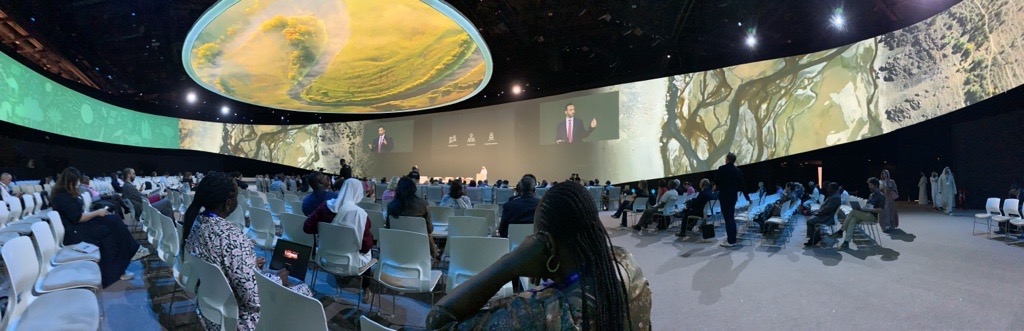
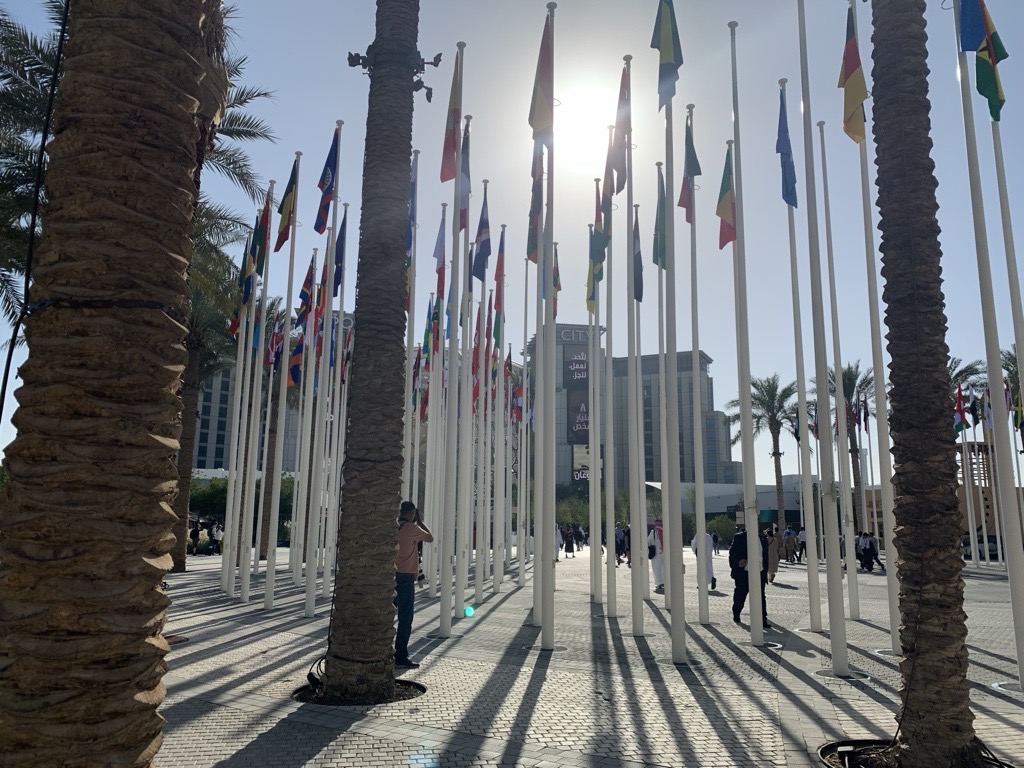
The conference ran over two weeks, and I was lucky enough to attend the entire first week. COP this year had a whopping ~100,000 people registered, almost double as many as COP26 in the UK two years ago. Nothing can quite prepare you for a conference of this size, it is completely and utterly overwhelming in every way – at least to those of us who are new to it. I spent much of the first two days in a state of confused stupor, trying to maximise every minute, but instead failing to take anything in or find anything. I cannot explain just how much was going on at the same time. The official UN program hosted the main negations but also several other official programs that ran simultaneously. And then there were the pavilions. You can think of these as the fringe festival. There were literally hundreds of pavilions, I counted 350-400 in the blue zone alone, there were even more in the green zone which is open to the public. Each pavilion has its own program of events, which was not published on the main COP website, although some did appear on the site’s list of pavilions with links to their own websites. For the most part, though, you had to find the pavilions you were after and their schedules directly from the pavilion hosts. So if you wanted to ‘browse’, like I did, you could only realistically cover a small area and discover a (relatively) small number of pavilions since the place was too big and there were just that many pavilions.
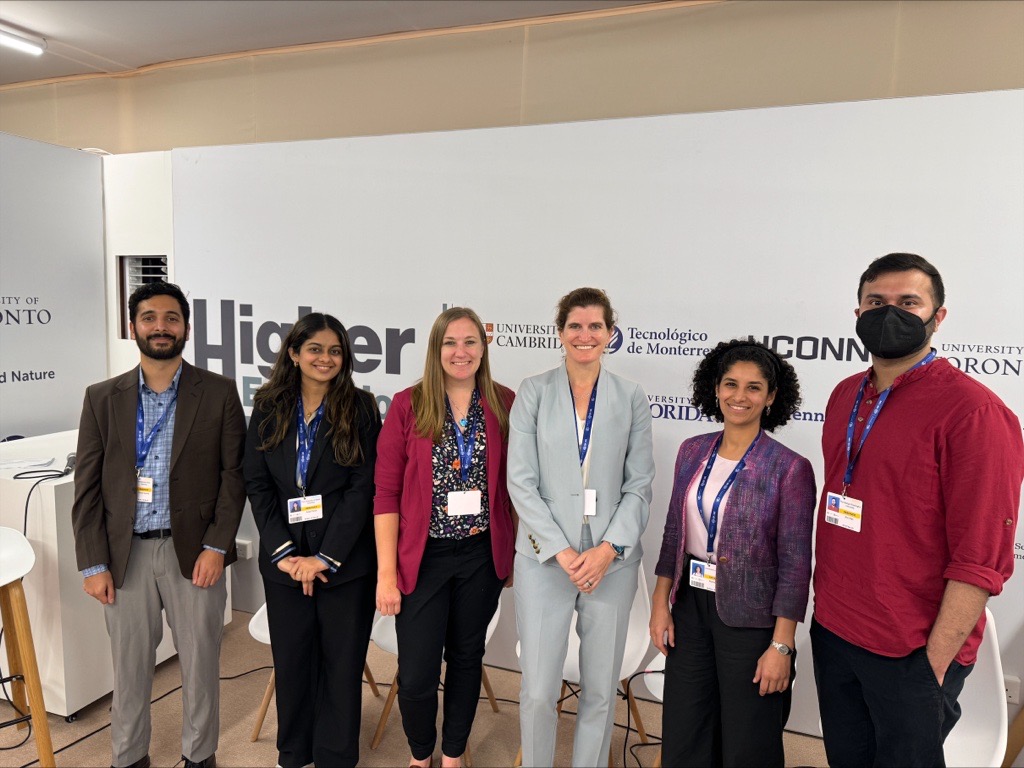
In fact, you could easily spend your entire time just sifting through programs and trying to decide what to attend. Even while sitting through an event, you could make the mistake of thinking you could multitask (what a fallacy!) and just quickly skim through the program to decide what to go to next so as to not lose too much time between events, and before you know it, the people talking have finished, you haven’t absorbed anything and are no closer to deciding what you should go to next. I started to fall into this trap on the second day, but was luckily snapped out of it by the fact that I was speaking at a panel, and therefore had to be somewhere on time and had to come with a mind clear enough to speak coherently. After that I decided to just get over my FOMO, pick one place for each half day and just stay there and actually make the most of it. This worked much better. The magic of COP is that pretty much everything is relevant, so while you will definitely miss out on some amazing talk somewhere, wherever you spend your time, you will also definitely get something useful out of it – once you put the programs down and start paying attention, that is. I will caveat this by saying that so many events made the mistake of preaching to the choir. Yes, there is always something to learn, however, COP gives an enormous opportunity for engaging people in collective action, so I was disappointed by the number of events whose distilled message was ‘we need to do more’. We all know we need to do more, that is why we came, the question is how and what. Luckily, there were also numerous events that (in my view) did it right, for example by launching an initiative and inviting people to participate in a clear way. One such example is We Mean Business’s ‘Fossil to Clean’ campaign. I was also impressed with several events at the ‘Global Action Hubs’ which showcased lessons learnt but also discussed what needs to happen next, where the blocks are, and ways to address these.
For my own work, I was seeking connections with the private sector, and so I tried to attend events targeting this category. However, I found the most constructive conversations were those I had randomly, waiting in queues or sharing tables during breaks, or even just riding the metro to the conference. There is so much amazing work out there done by so many amazing people, but the problem with the events is that almost all of them were talks or panel discussions with almost no time for the audience to ask questions. In fact, many of the pavilion events had more people on the stage than in the audience. It is my guess that so many of us partake in these ‘speaking’ roles to justify our attendance, but it means that everyone is on transmit mode and no one is listening. Yes, the panellists might have a good dialogue amongst themselves, as I experienced on my panel, but the opportunities to have real conversations and build collaborations beyond those panels only came in the random moments, when people are no longer ‘on’ with their prepared talking points. I observed this not to necessarily be true for people who knew each other from before, as they would have a pre-existing connection or topic of discussion that sufficiently caught their attention, so they would find a spot to sit down and talk. I did keep hearing something to the effect of ‘you can’t do work/business at COP’ as there is too much going on, which made me wonder why most people go, especially those who have been before and know what it is like (which seemed to be the majority). Is it to achieve an objective, raise awareness of one’s own work, or simply to be part of the tribe? I do believe that all of these are valid reasons, and contribute to the collective effort, but I think it’s important for us to be critical of our own agenda and reason for attending, particularly now that COP is getting so big, possibly too big?
I’ve seen COP fringe referred to as a ‘trade show’ or even a ‘circus’, and this makes me wonder, does the presence of COP fringe dilute the actual negotiations of the nations? Clearly I am biased here, but I’m inclined to think (or rather to hope) that a growing COP fringe sends a signal to the nations and hopefully puts some pressure for stronger climate action. I was reassured to see country delegates all around the pavilions, so they were also browsing and listening and discussing. I was also reassured to see open meetings bringing together the presidency, country parties and representatives of other constituencies such as the observer categories (which is where universities sit), meaning that there is some dialogue, even if it is not clear how much effect it has. But perhaps it’s worth remembering here that the COPs are not the only time in the year where this work is done, the work is being done continuously, and most of the impactful work (including country negotiations) happens before the COPs. The COPs are the culmination of all that work, when the nations all come together and publicly agree their commitments.
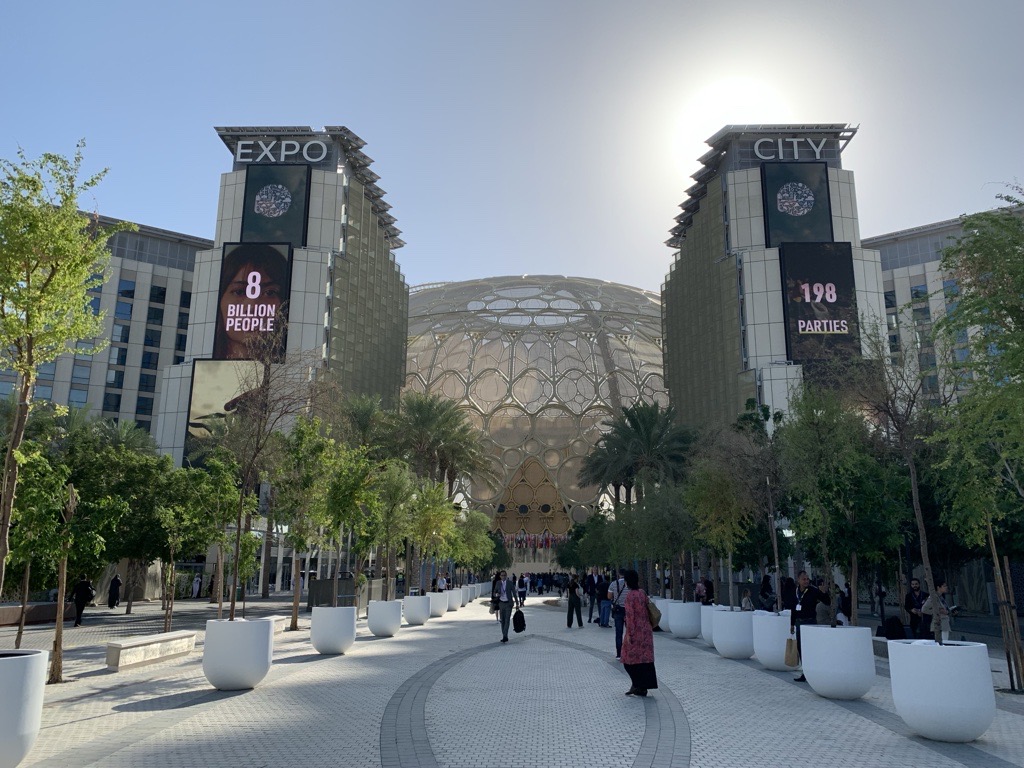
On a personal level, though, I must admit that attending a conference this big really put things into perspective. I was blown away by the sheer scale of the effort. Being there amongst ~100,000 people who have committed their efforts to this common cause, and who are a small representation of the global effort, it was humbling and reassuring. Particularly as this COP brought to light the first global stocktake since the Paris agreement in 2015 and it is not looking good. We are currently on track to 2.4-2.6deg warming by 2050, and the window to limit warming to 1.5deg, the limit thought to be less disastrous, is quickly closing. Having seen these figures just before COP, I arrived with some despair, but seeing for myself the enormity and breadth of the effort, I return home with renewed hope.
I was particularly pleased to see a strong focus on a just and inclusive transition, and a presence of indigenous peoples. I was also pleased to see a large attendance from across the private sector, including the finance sector who seemed to show a strong willingness to invest in green growth. Most of all, I was pleased to see the narrative start to shift from the green transition being a problem to be solved almost by regressing in human development and quality of life, and instead presenting it for the opportunity that it is: an opportunity to develop sustainably, moving humanity forwards and bringing everyone along, improving lives and habitats around the globe. This sentiment was echoed throughout the conference, whether it was the private sector discussing growth opportunities with huge economic potential, or the public sector discussing the growing job market that far outnumbers expected job losses, or local communities and NGOs discussing environmental repair and protection. The fact that the conference started with an unprecedented agreement on the very first day, a commitment to establish a loss and damage fund, meant that the conference started with acknowledgment that there is indeed vast damage to be repaired, and that the nations are willing to repair and reset the course. This was a good start.
There is still very much to be done, and the situation is such that we can no longer afford to be complacent, we need everyone’s full and unrelenting effort, and the reward will be enjoyed by all. I have always been quite cynical of the COPs, but I am now of the opinion that it is a Herculean effort to bring the world together constructively to solve a global problem. Yes, it is easy to criticise the process and the speed of the progress, but I now acknowledge it is a real effort to make progress and we are better off with it than without it.
In the end, I do not know if my personal attendance was worth the carbon cost of my flight, but I will strive to make it so. I return with renewed inspiration, motivation and commitment to maximise my contribution to the green transition, and I bring back lessons learnt, improved perspective, as well as numerous connections and collaboration leads. We all need to do our part, but none of us can work alone in a transition of this scale. I look forward to seeing our collaborations grow, growing our contribution to the green transition.
 Manar Alsaif
Leave a comment